Who Thought This Was a Good Idea Review
A former Obama staffer dishes on what it was like beingness the youngest female person higher-up in the Oval Office.
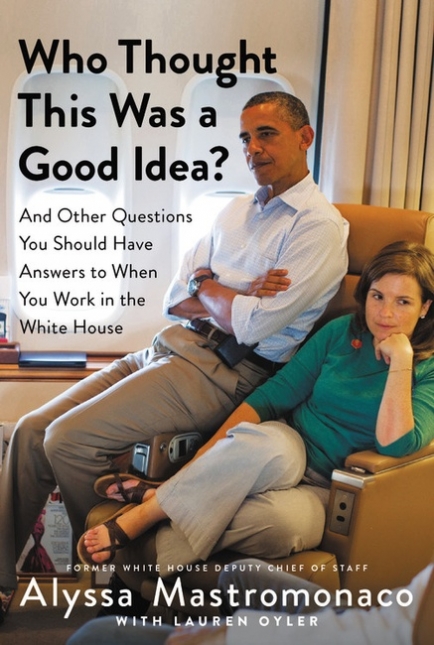
Political memoirs are often intimidating behemoths, and despite because myself a civic-minded adult female who follows politics, I tend to avoid them. The sometimes 400-plus-page tomes can be unappealing in their self-righteousness, with their black-and-white jackets featuring photos of the knowing, airtight-rima oris smiles of this former world leader or that ex-secretary of state.
Who Idea This Was a Good Idea? And Other Questions Y'all Should Accept Answers to When You Work in the White House by Alyssa Mastromonaco is a clear difference from the norms of the genre.
The memoir describes how Mastromonaco ended up in Barack Obama's inner circle, from her starting time encounter with politics (jumping on Newt Gingrich'south machine in protestation as an undergraduate) to becoming, at 32, the youngest woman to concur a senior position at the White Firm.
On the encompass, the author sits in a seat on what nosotros can only assume is Air Force Ane, with President Obama sitting on the armrest next to her. She's wearing sandals, and her anxiety are folded underneath her — a coincidental, candid photo that reflects the honesty of the book.
That honesty is of the unflinching, self-deprecating, maybe-this-is-bordering-on-too-much sort. Within the start 15 pages, the reader learns about how difficult it is to leave the White House to purchase tampons, which leads to a menstrual emergency in which Mastromonaco bleeds through her "blue-and-white houndstooth capris from J. Crew."
Twenty-five pages later, she describes bowel troubles while accompanying the president to meet the pope at the Vatican.
"The paintings, the architecture — you don't accept to be Catholic to retrieve it's incredible. It's an overwhelming place to have an IBS attack…This was the moment when I had to exercise some reckoning. What are my priorities? Am I going to tell someone I'm near to have diarrhea in the hopes of getting help?"
If the book sometimes feels similar it ventures too far into blench-inducing territory, the no-holds-barred style is ultimately its greatest strength.
Only like tabloid photos of famous actors chewing with their mouths open remind united states that "Celebrities are people, too!" this book reminds us that even those in the most high-powered jobs are no different than the residual of us.
Though the White Business firm is locked behind a six-foot-tall fence, requires a high-level security clearance to enter, and is patrolled past armed Secret Service personnel, for the people who work there, it's but an part. There are birthday parties with block. There are inter-role e-mail flirtations. There are moments that lead to stern scoldings from the boss.
Only, at the White House, when Mastromonaco is being reprimanded, information technology's by the president of the United States. When there's an emergency at piece of work, information technology's because at that place's an emergency in the world. The stakes are high, like when she was one of the people leading the executive branch's response to Hurricane Sandy.
At a meeting on how to answer to that natural disaster, Mastromonaco had to overcome self-doubt to vocalization her idea of making a PSA informing people how to get help.
"For some people (like me), gathering the courage to speak up in meetings is a skill that requires practice. There are the normal fears — that you'll sound stupid, that anybody else has already thought of what you lot're going to say and has moved on, that what you idea was a foolproof plan has an obvious hole in it. And so there are the fears that you lot develop when your meetings are with the most important and powerful policy makers in the state."
Even people at the White Business firm become too nervous to speak up during meetings. Stars: They're just like us!
Toward the cease of the book, Mastromonaco tells us her motivation for wanting to share her feel: "The idea was an advice volume/memoir geared toward women between the ages of 15 and 25…I hoped it could assistance women see themselves in government."
Alas, the parts when the "advice book" goal becomes likewise obvious are the weakest. Twice during the book, Mastromonaco breaks away from her narrative to give tips on preparedness and finances. The interludes are awkward, shallow, and inconsistent departures from her story.
There are plenty advice books out in that location that tell u.s.a. near the importance of credit scores. And we already know about getting a skillful night's sleep. Her experiences at the White House, holding the highest position a adult female always held in that location at her historic period, are what make her unique. The lessons that stay with the reader are buried within the narrative, when she shows instead of tells.
Ultimately, Mastromonaco convinces united states that if you have a little bit of tenacity and aren't scared of embarrassing yourself, you may just end upward working side by side with the president. She's someone who's smoked pot more times than she can count, loves the Grateful Dead, and didn't become to an Ivy League higher.
If she did it, you tin, as well. And, hey, information technology won't happen unless you lot try.
Avery J.C. Kleinman is a producer for the Kojo Nnamdi Show, a program on WAMU 88.v FM, Washington, DC's NPR station. Follow her on Twitter at @averyjck.
Like what we do? Click here to support the nonprofit Independent!
Source: http://www.washingtonindependentreviewofbooks.com/index.php/bookreview/who-thought-this-was-a-good-idea-and-other-questions-you-should-have-answer
0 Response to "Who Thought This Was a Good Idea Review"
Postar um comentário